

A rate hike on Wednesday is now very likely but would also be unusual, and perhaps dangerous, at least as far as the past generation of monetary policy goes.
Why likely? Because the US has experienced both above-consensus job growth and above-consensus inflation. As a result, futures markets are pricing in three to four rate hikes in the next 12 months. We’re not there yet.
But even one 25 bps hike would be unusual given that the Fed started cutting rates about two years ago. Rate hikes, in the midst of an easing cycle, are unusual. Moreover, Fed policymakers believe the long-term neutral federal funds rate is somewhere between 3% and 3.25%, which is below the current target of 3.5% to 3.75%.
Normally, or at least in the past generation, once the Fed starts cutting rates, it keeps cutting rates until rates reached a long-term bottom. Going backward in time, that is what happened before and during COVID, before and during the Global Financial Crisis, as well as during the collapse of the first internet boom in 2000-02.
All three of these episodes included a recession that the Fed felt it could alleviate. For now, at least, a recession does not seem to be in the cards so the Fed is less worried about that. It’s more worried about inflation.
The last time the Fed raised rates during a general rate-cutting cycle was in early 1997 under then-Chairman Greenspan, who justified the one-time quarter-point hike based on strong economic growth that he thought was due to a “wealth effect” from booming stock markets. Using a Keyneisan approach, the Fed was worried that low unemployment (then just above 5%) could stoke inflation even though it hadn’t happened yet.
This same thing is playing out today. The unemployment rate is 4.1%, the Atlanta Fed projects third quarter real GDP growth at 4.4%, investment in data centers is soaring, and inflation remains stubbornly high.
All of this is complicated by multiple wars. Energy prices have spiked because of the conflict in the Middle East while the Ukraine-Russia conflict has reduced global refining capacity. But, there is nothing the Fed can do about this and hiking rates during war-time is highly unusual.
It’s also important to realize that just because the Fed reduced rates from mid-2024 through late-2025 and was trying to reach a target rate of 3.1% doesn’t mean it will continue to try. That 3.1% is a guess.
As Chairman Warsh pointed out in Jackson Hole, AI and the investment in data centers is a wild card. It could lift productivity growth, which would reduce inflation. But it could also be over-investment (like fiber optic investment during the late 1990s) that comes to an abrupt end.
One thing is for certain. The buildout of AI and data centers, which has been rapid, is not as rate-sensitive as the rest of the economy which is not performing nearly as well. Housing in particular is very weak, and rate sensitive! In other words, raising rates may not slow AI, but it will impact other areas of the economy.
Another important point is that in 1997, when Greenspan hiked rates, interest rates and the money supply were tied together because the Fed operated under a system of scarce reserves. Now, with abundant reserves, a rate hike will not directly influence the money supply in the same way. If rates rise, but the money supply grows, the rate hike will have less impact on inflation than investors (and the Fed) seem to think.
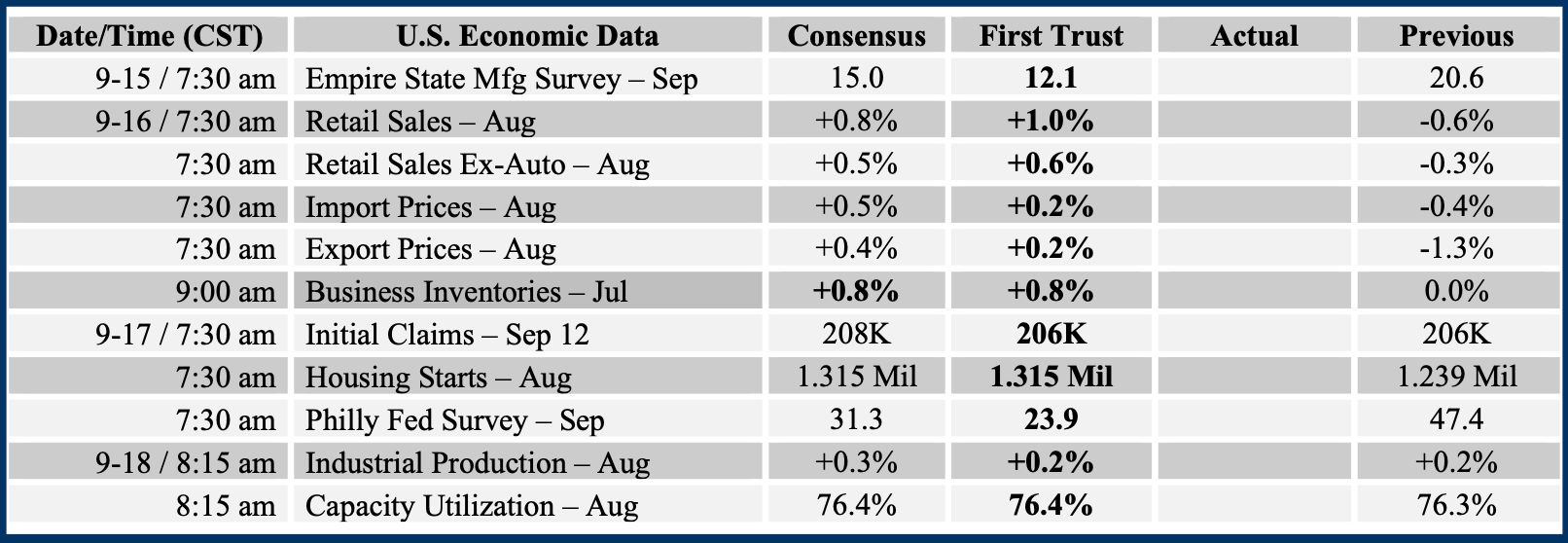
Consensus forecasts come from Bloomberg. This report was prepared by First Trust Advisors L. P., and reflects the current opinion of the authors. It is based upon sources and data believed to be accurate and
reliable. Opinions and forward looking statements expressed are subject to change without notice. This information does not constitute a solicitation or an offer to buy or sell any security.